Macarons: A Complete Guide, from Spotting One to Storing It

A macaron is small, but there is more to know about it than you might expect. This guide covers what a macaron is and what it isn't, what sits behind the price, how to spot a good one in three seconds, how to store it properly, which flavour suits whom, and how to choose a gift box. Short answers to the most common questions come at the end.
What Is a Macaron?
A macaron is a French confection: two thin shells made from almond flour, icing sugar and egg white, with cream, ganache (chocolate melted into hot cream) or a fruit filling between them. There is no wheat flour in the recipe; the shell's structure comes from almond flour plus whipped egg white — pastry chefs call that foam a meringue. Change the ratio of those two and the result changes with it: the shell either cracks or spreads flat. A properly baked macaron has a smooth, faintly glossy top and a small lacy rim underneath, known as the 'foot'. Bite into it and a fine crackle comes first, then a soft centre — that double sensation is the whole point of a macaron. Small as it is, the macaron is one of the most demanding items in a pastry kitchen: mixing time, resting the batter, oven temperature and the humidity in the room all show up in the result. Which is why the first question is usually the same one: why is such a small sweet so expensive? The answer starts a step earlier — with the confusion hiding in its own name.
Macaroni, Macaron and Macaroon: Three Different Things
In English the trap is a single letter: macaron and macaroon are two different sweets, and macaroni — the pasta — sits only a step away, so 'I'm ordering macarons' can be heard in more than one way. The pastry meant here is the French macaron, made in the Parisian style: two shells with a filling between them. A macaroon is something else entirely — a single, craggy-topped biscuit made from shredded coconut, with no filling at all. It looks nothing like a French macaron and tastes nothing like one either, yet the two words get mixed up constantly in search, and people end up staring at the wrong picture. Telling them apart is simple: a French macaron is always two smooth shells with a filling, usually in pastel colours. The coconut version is one piece, rough on top, and has nothing inside. Once that is clear, the next question gets more interesting: why does a macaron cost so much more than an ordinary biscuit of the same size?

Why Are Macarons Expensive?
Most of the answer sits in one ingredient: almond flour. It costs far more than wheat flour and nothing replaces it in a macaron; cut the amount and the shell loses its structure. The second factor is labour: shells are piped by hand, rested, baked, then paired up and filled one by one. The third is waste — shells that crack, come out without a foot or miss the right size never make it into a box, and that loss is part of the price. The filling isn't cheap either: real chocolate ganache, natural fruit purée or pistachio paste push the cost up noticeably. Finally there's packaging. A macaron breaks easily, so getting it to you intact takes a fitted tray, a rigid lid and a protective layer. In other words you are paying not only for the sweet, but for it arriving whole. How the price shifts with box size and contents is set out briefly in our questions about prices. Expensive, though, does not automatically mean good — so the next step is to stop looking at the price and learn to look at the macaron itself.
- Almond flour is the macaron's structural backbone — finely ground, sifted, and impossible to swap for cheap flour.
- Shells are piped by hand, left until a thin skin forms, then paired and filled one at a time.
- Cracked shells, footless shells and off-size shells never find a partner — that loss is built into the price.
- Every flavour needs its own filling: natural fruit purée and real chocolate ganache cost far more than artificial flavouring.
- The fragile structure calls for a fitted tray and a rigid lid so nothing knocks together in transit.
How to Spot a Good Macaron in Three Seconds
You don't need a trained palate to spot a good macaron — three seconds of looking will do. Start at the bottom edge of the shell: there should be a thin, slightly ruffled rim. Pastry chefs call it the 'foot' (pied in French), and it shows the batter rose properly in the oven. No foot means the batter was overmixed or the bake was off. Then look at the top: smooth, even, crack-free and faintly glossy; a dull, dusty surface says the drying stage went wrong. The macarons in one box should be close in size and height — a sign every shell was piped the same way. As for colour, pastel shades are a good sign; very bright, neon tones usually mean a lot of dye and add nothing to the taste. In the shop you can run one more quick check: the edges should look naturally wavy, not cut with a ruler. These are all outward signs; the real difference shows after the first bite, in the ratio of shell to filling.
- Look at the box from the side: every shell should show a thin lacy 'foot' underneath.
- Held to the light, the surface should read smooth and faintly glossy, not dull and dusty.
- Shell heights should be close to one another; a wide spread points to an unstable bake.
- Keep to pastel colours — a neon shade signals dye, not flavour.
- Pressed gently with a finger, a macaron shouldn't crumble; it gives a little and springs back.
The Shell-to-Filling Ratio — The Real Secret
A macaron succeeds or fails on the balance of three layers: shell, filling, shell. Too little filling and you're left with a dry, floury feel; too much and sugar swallows everything, blurring the flavours. Here's a rule worth remembering: the filling should take up roughly a third of the total height and reach the edges, rather than sitting like a dot in the middle. The order of the bite tells you the same thing — a fine crackle, then the soft almond layer, and only then the cream. If all you taste on the first bite is cream, the ratio is off. The type of filling sets the character: ganache is rich and lingers, fruit-based fillings are tart and light, pistachio and caramel push the sweetness up. A well-composed box balances those three characters so the fifth macaron is as interesting as the first. One more detail matters: when the filling is too cold, none of that balance comes through. Which is exactly how most macarons lose their flavour on day one — with the best of intentions.

A Common Myth: 'A Freshly Baked Macaron Is Best'
Here's a belief you hear a lot: a macaron should be eaten straight from the oven, still warm. The opposite is true. Once filled, a macaron needs a night in the fridge — over those hours moisture from the cream moves into the shell, so the top layer stays thin and crisp while the inside softens. Pastry chefs call this maturing; a freshly filled macaron often tastes dry and hollow. The second common mistake is eating it straight out of the fridge. Cold hides the aroma of both almond and chocolate, and the flavour goes flat. The right move is to take the macarons out 15–20 minutes before serving and let them come to room temperature. You can test this today: take two macarons of the same flavour, eat one straight from the fridge and leave the other on a plate for 20 minutes. The difference is obvious enough that you'll never serve a cold macaron to a guest again. So the question that matters isn't 'when was it baked' but 'how was it kept' — and that comes down entirely to a few habits at home. None of them is difficult.
How to Store Macarons and When to Eat Them
A macaron both loves moisture and fears it. Left out in the open, the shell draws in damp and softens; in a dry, air-conditioned room it does the reverse and turns brittle. The best place for it is a closed box or an airtight container. The fridge works, with one condition: keep it away from strong-smelling food. Almond and chocolate pick up aromas easily, and a box that has been sitting next to cheese or onions can taste spoiled long before it actually is. The freezer is an option too — the macaron is one of the few sweets that freezes well — but it should go in a sealed container rather than uncovered, and thaw slowly at room temperature. There's no single answer to how long you can keep them, because it depends on the filling: fruit-based creams change faster, chocolate ganache holds longer. The most reliable route is to ask the boutique for the recommended window for the box you bought. With storage settled, the nicest part is left: choosing the flavours.
- Keep macarons in an airtight container rather than on an open plate.
- In the fridge, choose a shelf well away from strong-smelling food.
- Storing them for several days? Use an inner shelf with a steady temperature, not the door.
- When freezing, keep the container sealed and thaw slowly at room temperature.
- If the box holds mixed flavours, eat the fruit-based ones first.


Which Flavour Suits Whom?
Flavour is a matter of personal taste, but when you're buying a gift a few simple pointers make it easier. Chocolate and caramel are familiar and low-risk, so filling half the box with them makes sense for someone whose preferences you don't know. For anyone who likes a tart note there's raspberry, lemon, tangerine and orange; these cut the sweetness and go well with coffee. Vanilla and rose have a finer character, suited to a tea table; Turkish coffee is an interesting middle ground — a familiar taste in an unexpected form. For children, strawberry and chocolate are the easiest choice, while pistachio macarons are for people who like a rich, full flavour. If someone is after a deeper chocolate note, handmade premium chocolates are a direction of their own. The most practical approach is to keep 4–6 different flavours in one box: the person opening it finds their own favourite, and the box never feels monotonous. Once the flavours are settled, one question remains — the box itself.
- Buying for someone whose taste you don't know? Start with chocolate and caramel.
- If it's served with coffee, pick tart flavours — raspberry, lemon or tangerine.
- For children, strawberry and chocolate are the safest bet.
- Keep 4–6 different flavours in one box so there's a choice.
- With pistachio and nut fillings, ask about allergies in advance.
How to Choose the Gift Box
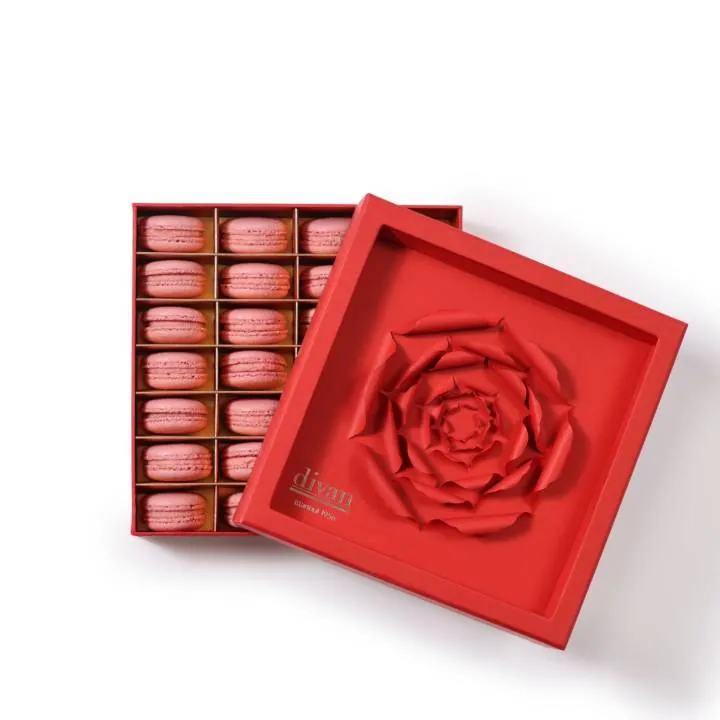
The box is half of a macaron gift. For a small thank-you, a 6- or 8-piece size is plenty: it looks considered without putting the other person in an awkward position. For visiting someone's home, a birthday or a business meeting, boxes of 12 and 16 work better, because they can be shared. For engagements, anniversaries and special congratulations there are large gift boxes, along with options like the red rose box — a Divan design — which is a presentation piece in itself and needs no extra wrapping. You can look through all the sizes and flavour pairings on our macaron boxes and flavours page. Company orders follow a different logic: what matters there is that the boxes look identical, the names are spelled correctly and the presentation is consistent — a format covered separately under corporate gift boxes. One last detail: macarons should stay horizontal while being carried. Don't set the box on its side in the car or leave it by a hot window — a well-chosen box can't do its job if it travels badly.
Frequently asked questions
Are a macaron and a macaroon the same thing?
No. A French macaron is two smooth shells made from almond flour, icing sugar and egg white with a filling between them. A macaroon is a single, rough-topped biscuit baked from shredded coconut, with no filling at all. The two words sit one letter apart, and macaroni adds to the confusion, so when you mean the dessert it's clearer to say 'French macaron'.
How do you recognise a good macaron?
The quickest check is from the side: if there's a thin lacy rim under the shell — what pastry chefs call the 'foot' — the batter rose properly in the oven. Then look at the surface: smooth and faintly glossy, with no dusty bloom or cracks. If the macarons in a box are close in height, they were all made the same way. The last check is the bite: a fine crackle first, then the soft almond layer, and only then the cream.
Why are macarons considered an expensive sweet?
Several costly steps stack up. The main raw material is almond flour, considerably dearer than wheat flour, and shifting its proportion means you simply don't get a shell. The shells are handwork: piped, left until a thin skin sets, baked, then paired and filled one by one. Cracked or off-size shells never reach the box, and that loss lands in the price too. Add natural fruit purée, real chocolate ganache and a fitted box that protects the fragile structure, and the cost climbs further.
Can macarons be kept in the fridge?
Yes, but in a sealed container and away from strong-smelling food. Almond and chocolate absorb aromas quickly, so a box left next to cheese or onions can lose its flavour. Take them out 15–20 minutes before serving and let them reach room temperature, because cold flattens the taste. How long they keep depends on the filling: fruit-based creams change faster, chocolate ganache holds longer.
Can macarons be frozen?
You can — the macaron is one of the few desserts that takes freezing well. The conditions are simple: freeze it in a sealed container rather than uncovered, and thaw it slowly at room temperature, not in a microwave. Don't refreeze after thawing: the shell draws in moisture, the crispness goes and spots can appear on the surface. The best approach is to set aside only as much as you'll eat and thaw just that.
Where can you order a box of macarons in Baku?
L'Oben Premium is the official exclusive distributor of Divan İstanbul in Azerbaijan, presenting Parisian-style macarons at its boutique in Ağ Şəhər (White City), Baku. Address: 2-ci Yaşıl Ada küçəsi, Ağ Şəhər, Baku; the boutique is open every day, 08:00–23:30. To choose a box size and a flavour mix, message us on WhatsApp or call +994 51 324 64 34.
If you can't decide which flavours to pick, message us on WhatsApp — we'll choose the box size and the flavour mix for your occasion together. Our boutique in Ağ Şəhər (White City) is open every day, 08:00–23:30.
2-ci Yaşıl Ada küçəsi, Ağ Şəhər (White City), Baku · every day 08:00–23:30



Published by: L'Oben Premium
Last updated: